How and why you should use reference songs to collaborate.
Why communicating taste is the most important tool for collaborating musicians:
I'm a freelancer songwriter. A couple years back, I get a brief for a sad, acoustic folk song. The client, (we'll call him Joe), gives me creative license for the topic and says he trusts my ears, so I write a heart wrenching allegory based on my toughest personal experiences, through finger picked acoustic guitar, tender melody and metaphorical lyrics.
I know in my naive little heart that Joe's going to love it. I mean, he asked for Sad, Acoustic Folk. This is it! I'm the perfect guy for the job. Acoustic guitar? Check! A childhood obsessed with Billy Joel, filtered through a lifelong emo phase? Check! Unresolved trauma and self worth issues, let's go! Shit, I've probably bought Sufjan Steven's like 3 coffees, streaming Carrie and Lowell…
So I hit send, and impatiently wait for the 5 star review I know is on it's way.
A couple days later, I find a response in my inbox. Excited, I open the mail and read: "Hey dude. Thanks 4 ur hard work, but this isn't what I asked for at all. Why is it so depressing? This sounds like weird suicidal country. I wanted sad acoustic folk, like The Lumineers. This isn't it man. Pls can we cancel the order."
My gut instinct is to tell him to piss off. He clearly has no idea what sad, acoustic folk means. Justin Vernon could sit down in Joe's kitchen and sing Re: Stacks, and Joe would would interrupt him and ask if he knows how to play Ophelia, or some other stomp clap nonsense.
I'm angry. He doesn't get it. He doesn't get me.
I craft a passive aggressive message, to make sure he understands exactly what Sad Acoustic Folk means. But thankfully, a nagging feeling stops me from hitting send. So I save it as a draft, and head out for a walk. I'm fuming. Kicking rocks and moaning to myself about shitty clients with bad taste. When all of a sudden a thought hits me, stopping me in my tracks.
Taste. I assumed his taste was the same as mine.
My context was Fleetwood Mac, Bon Iver, and Mount Eerie.
But for Joe? A break up song, stomped and clapped by The Lumineers.
He failed to effectively express his taste. I failed to clarify. We failed to communicate.
Defeated, I get back from my walk, and slump into my office chair... An official order cancellation request stares at me from the screen, breaking a perfect streak, reminding me that this is my fault. As a freelance songwriter its my duty to clarify what my clients want...
I take a deep breath, click "accept" and watch the money I was supposed to earn disappear. I promise myself I'll never again assume someone's taste, especially based on some vague genre label.
By the end of this article you’ll understand why I think reference songs are the ultimate collaborative tool. If you aren't using them, start now!
What is a reference song?
It's a song that expresses your taste or creative vision, paired with notes. Which can be general - "I like the aggressive vibe in this song." Or specific - "That bASS tone at 2:36 f#^$ing slaps."
The problem collaborators face
My client wanted a “sad, acoustic folk song.”
- But sad could mean Mount Eerie or Coldplay.
- Acoustic could be Jason Isbell's “Elephant”, or Tallest Man On Earth's ”Love is All”
- Folk could mean Tracy Chapman, or Mumford and Sons.
You see the problem? Words aren’t enough to describe the music in your head, because your context for each word is different to mine.
Think of a dog.
Rottweiler or a Pomeranian? Cute and fluffy, or a rabid monster?
Does cute mean a pug with bulging eyes and tongue that hangs out? A chihuahua? A border collie, bull terrier? Which is cuter?
It all depends on your personal context.
But if you see this sweet little guy:

You know exactly what I’m talking about.
Why reference tracks are the solution
A picture’s worth a thousand words? A reference track is the musical equivalent.
Your taste is obvious to you. You're in a lighthouse with night vision goggles. Your collaborator’s in a rubber dingy, braving the opaque darkness of your mind, praying they don't wash up against a giant squid or iceberg.
You can call out phrases like "sad acoustic folk", "iceberg ahead", "Norwegian black metal saxophone solo", "SHAAARK!!!", etc. Or you could fire up the lamp so they can see for themselves. That's what reference tracks do.
They also show us where our tastes intersect and help us figure out if we're a good creative fit. Send me Pheobe Bridgers’s - Moon Song, and I might cut my freelance fee in half. Send me Tones and I - Dance Monkey, and I'll suggest another songwriter. (after cleaning the vomit off my keyboard and taking my foot out the monitor)
Nobody has identical taste. The magic of collaboration is how 2+ creator’s styles and influences collide to form something new. But to write music we both/all enjoy, we need some common ground. If we have polar opposite views on what makes a good song, let's find out ASAP.
How to use Reference Tracks
1) Listen to music.
2) Save your favourite songs to a “references” playlist. I like digital notes with embedded YouTube links because:
- You can write notes directly under the reference track.
- It’s all text, so you can share your ideas with a simple copy/paste.
- YouTube links don’t require your collaborator to sign up before listening.
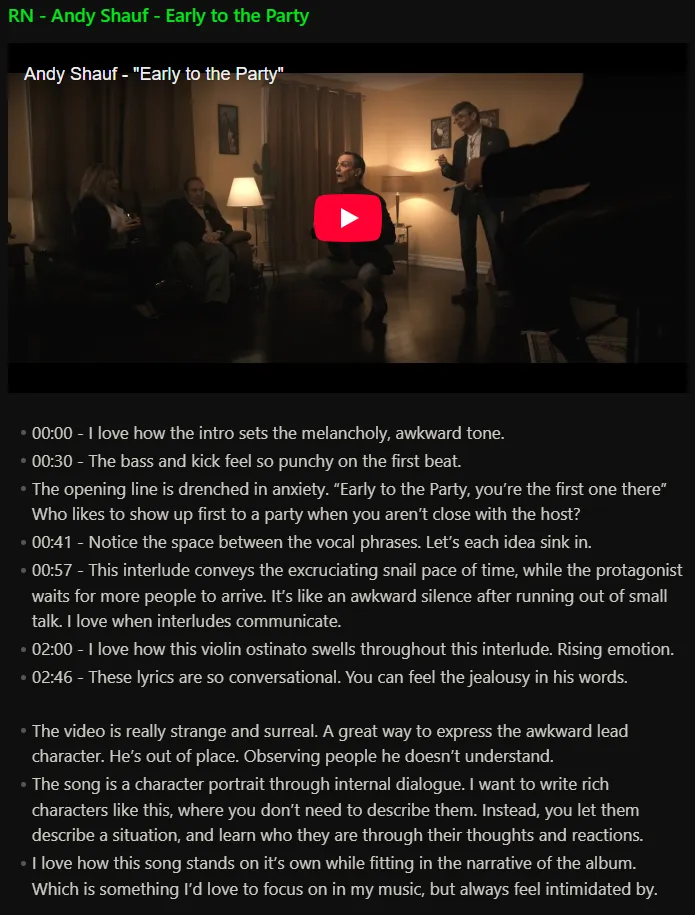
3) Write down whatever you find inspiring/noteworthy about your reference tracks. Keep your notes organised with bullet points, and time stamp whenever possible to give examples for what you're talking about.
Here’s one of my reference notes:
4) Share relevant reference tracks/notes with collaborators. Cut out songs or notes that aren’t relevant to the project at hand. For the sake of clarity, only explain your goals for this colab, and save the extras for another day. 2 to 3 songs is the sweet spot, with as many notes as you need.
Final Thoughts
You know what music you want to make. But it’s your ability to articulate your taste that gets it done.
Reference tracks help build, refine and communicate your creative vision. Make it a habit, and you'll soon have a treasure trove of references. Like a personal index for your taste.